The roofer’s estimate says $20,000. The first check from the insurance company says $6,000.
That gap catches a lot of Texas homeowners off guard after a hailstorm, and it usually comes down to two things: the deductible and depreciation. Getting that depreciation money back later depends on which settlement terms your policy uses, replacement cost or actual cash value.
In one line: replacement cost pays for the new shingles, drywall or couch at this year’s prices, while actual cash value knocks age and wear off that figure before it pays anything. On a microwave the knock is pocket change, but on a whole roof it can run well into five figures, which is why we’d rather you find out which one you have now than in a driveway full of hail.
How is replacement cost different from actual cash value?
Picture the sofa that’s been in your living room since the kids were in diapers, and a grease fire in the kitchen fills the house with smoke and ruins it. Under replacement cost (RC), the insurer prices a comparable sofa at the furniture store this month (same grade, not the leather sectional you’ve had your eye on) and doesn’t knock a thing off for the juice stains or the sagging middle cushion.
Actual cash value (ACV) starts from that same price and subtracts depreciation, so you’d get roughly what that tired old sofa was worth the morning before the fire.
Run the same idea with a TV. A burglar walks out with your six-year-old TV, and a comparable new one costs $1,000 today. With replacement-cost coverage on your belongings, the claim is figured at $1,000 before the deductible. With ACV, the insurer depreciates the set based on its age and expected life, so the payout might be closer to $300, or less, depending on how the company calculates it.
How does depreciation work on a roof claim?
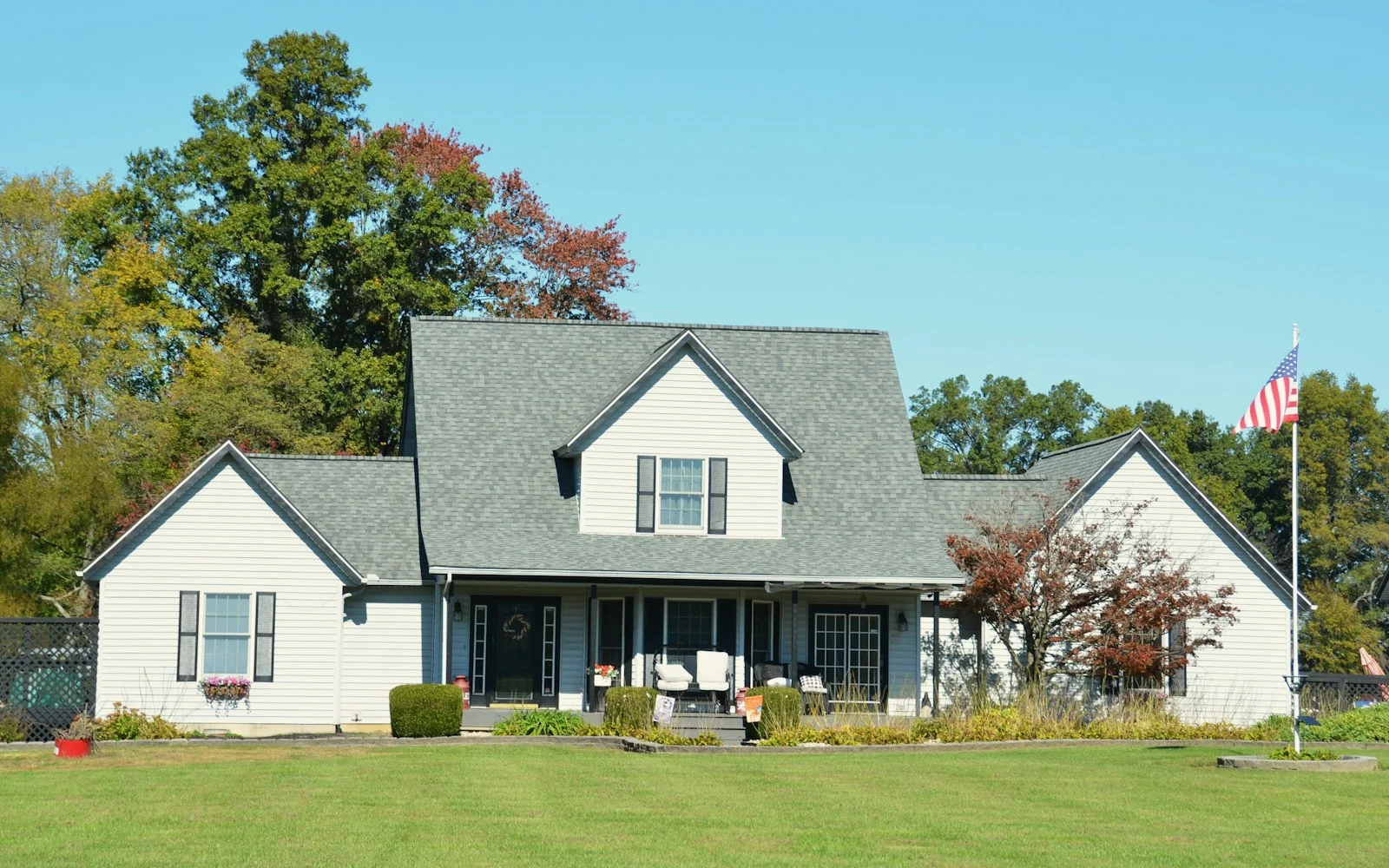
Roofs are where this gets real, so let’s run the numbers on a made-up house in Rosehill.
Say a spring hailstorm wrecks a 12-year-old shingle roof. Replacing it costs $20,000. The insurer figures the roof had already used up a good part of its expected life and applies $8,000 in depreciation, which puts the actual cash value at $12,000. The policy has a 2% wind and hail deductible on a $300,000 dwelling limit, or $6,000.
On a replacement-cost roof, that first check generally works out to the ACV minus your deductible, so $12,000 less $6,000, and a $6,000 check shows up in the mail. Most folks are pretty upset when they open it. The other $8,000 hasn’t vanished, though; the insurer is sitting on it as recoverable depreciation until the new roof is actually up, and once the crew packs up and you send in the final invoice (or whatever proof your company wants), many policies release it, which puts the insurer at $14,000 and, along with your $6,000 deductible, covers the whole $20,000 job.
If the roof is covered at actual cash value, that first $6,000 is the whole payment. The $8,000 in depreciation is gone for good, and you’d fund $14,000 of the new roof yourself.
Same storm. Same roof. An $8,000 difference.
Why are so many Texas roofs paid at actual cash value?
Texas gets a lot of hail, and roofs take the brunt of it. On many Texas policies, older roof surfaces are settled at actual cash value through an endorsement or a roof payment schedule, even when the rest of the house is insured at replacement cost. A payment schedule typically pays a smaller percentage of the roof’s replacement cost as the roof gets older.
These endorsements usually focus on the roof covering itself. How they treat decking, flashing and other parts varies, so read the wording or ask us to. If you’ve been through a storm claim before, our post on what homeowners insurance usually covers after a Texas storm is a good companion to this one.
Is personal property covered at replacement cost?
Not unless you asked for it, in a lot of cases. It’s pretty common for a policy to cover the house at replacement cost and then settle your belongings at actual cash value, unless replacement-cost coverage for contents got added.
On a single stolen bike, the difference is small. On a whole-house loss after a fire or a burst pipe, it isn’t. Think about eight-year-old couches, a closet full of clothes, a garage of tools and every kitchen gadget you own, each one depreciated on its own schedule. It adds up fast.
Either way, a home inventory helps. Walk through the house with your phone recording video, open the closets and the garage cabinets, and save receipts for anything expensive in a cloud folder. After a loss, it’s a lot easier to prove what you owned, and how old it was, when you’re not trying to remember from a hotel room. Our guide to what a standard homeowners policy covers in Texas shows where personal property fits in.
Why would anyone choose actual cash value?
Price, mainly. ACV coverage generally costs less, because the insurer expects to pay less on claims. For an older home, a rental house or a household watching every dollar, that can be a reasonable trade, as long as you go in knowing you’ll cover the depreciation gap yourself after a loss.
Sometimes it isn’t really a choice. On an older roof, ACV may be the only settlement option an insurer offers. That’s one reason roof age keeps coming up when people ask why homeowners insurance goes up in Texas, and why a newer roof can open up better options.
What if you don’t repair the roof or replace the item?
Under most replacement-cost policies, you’ll typically receive only the ACV payment until the work is done. Policies often set a time limit for finishing repairs and claiming the held-back depreciation, so don’t let the paperwork sit in a drawer.
Some people take the ACV check and live with the old roof. That’s their call. Just know that damage left unrepaired from one claim generally won’t be paid a second time, and an insurer may want to see it fixed before renewing.
How can you tell which one your policy has?
It takes about ten minutes:
- Pull up your declarations page and find the dwelling and personal property lines.
- Look for the words “replacement cost” or “actual cash value” next to each one; sometimes the settlement terms only appear in the policy form itself.
- Scan the list of endorsements for anything mentioning roof surfaces, a roof payment schedule or cosmetic damage.
- If any of it’s unclear, send it to us and we’ll translate.
Frequently asked questions
What’s the difference between recoverable and non-recoverable depreciation?
Recoverable depreciation is held back on a replacement-cost claim and paid once repairs or replacement are finished. Non-recoverable depreciation is never paid, which is how it works when property is covered at actual cash value.
Can my roofer cover my deductible?
No. Texas law prohibits contractors from waiving, rebating or absorbing your insurance deductible. A roofer who offers to “take care of it” is asking you to be part of something illegal.
Does replacement cost mean I get a new roof for free?
Afraid not. Your deductible still comes off the top, and the insurer is paying for a roof comparable to the one you lost, not the nicer one you’ve been eyeing. If you’d like to step up from basic 3-tab shingles to impact-resistant ones, for instance, the price difference generally lands on you.
Is actual cash value the same as market value?
No, and mixing the two up causes a lot of confusion. What your house would sell for depends on the lot, the school district and what buyers around Tomball are paying that spring. ACV on a claim ignores all of that and looks only at what fixing the damaged part costs, less depreciation.
What’s this “extended replacement cost” I keep seeing?
It’s a cushion above your dwelling limit. If rebuilding costs spike, which tends to happen after a big storm hits the whole region and every roofer and drywall crew is booked, some policies will pay a set amount past the limit. Not every company offers it and the size of the cushion varies, so ask us about your house.
Want to know how your roof would be paid?
Bring us your declarations page. Call Reid & Associates at (281) 716-5814, visit 703 Malone St. in Tomball, or get in touch online, and we’ll show you how your homeowners policy settles a roof claim before hail season instead of after.
The examples here are hypothetical and for general information only, not a statement of coverage. Your policy’s terms, limits, deductibles, endorsements and exclusions determine any payment, and availability varies.